
Why the growth of the GLP-1 category exposes invisible stockouts in pharmacies
The demand surge for GLP-1 impacts the pharmaceutical channel unevenly, creating false stockouts and idle inventory that require point of sale visibility.


The accelerated growth of high-impact health categories, such as treatments classified as GLP-1, immediately alters the routine of the pharmaceutical channel. The pressure on supply does not occur uniformly. While an urban chain sells out its inventory in a few days, units in other regions keep the product on the shelf without equivalent turnover.
Traditional market analysis looks at consolidated global volume and concludes that production meets consumption. However, aggregated data hides the reality of the point of sale. The premise that overall sales growth guarantees availability in every pharmacy ignores the frictions in the distribution chain.
The difference between global volume and availability at the POS
The main obstacle in managing complex categories is confusing industry sell-in with actual sell-out per store. When demand for GLP-1 skyrockets, visible inventory disappears long before the standard replenishment cycle can react. The result is localized stockout, which affects revenue and consumer trust in the brand.
Field teams and sales managers often debate product shortages based on fragmented reports or outdated spreadsheets. This approach generates slow correction cycles. The team tries to resolve a specific availability failure with generalist meetings, without knowing which chains or cities require immediate action.
How to separate real stockout from demand fluctuation
To act with precision, the team needs to isolate product behavior at each point of sale. The oscillation may just be a short-term seasonal fluctuation or the effect of a specific campaign that normalizes the following week. When the variation is structural, the lack of daily visibility turns the shortage into a permanent loss of market share.
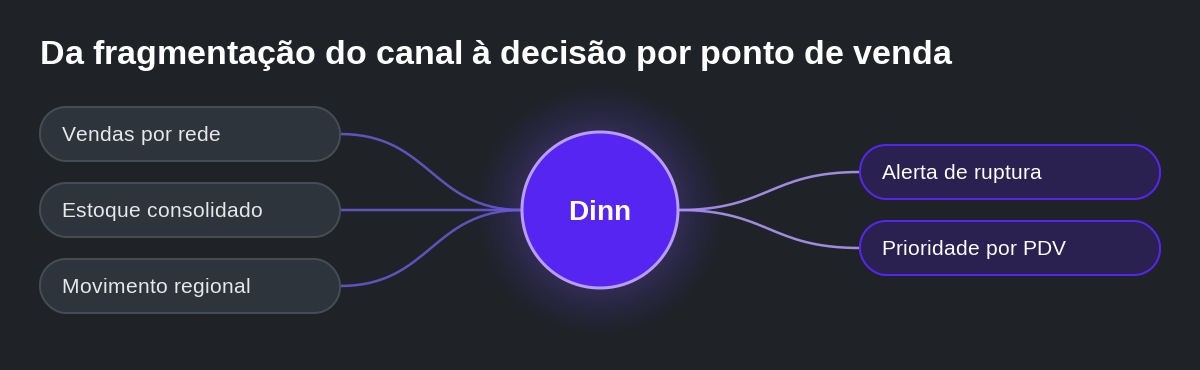
The intelligence layer acts precisely in this interval, connecting fragmented data to indicate where there is a real risk of stockout and what priority should guide the trade marketing team. Using tools like Dinn Stock, available to guide action by SKU and chain, allows commercial efforts to be directed based on observed and estimated evidence.
The limit of visibility in the pharmaceutical retail
No market analysis completely eliminates the logistical complexity of the channel. Independent pharmacies and regional chains have distinct replenishment dynamics and do not always provide direct digital inventory signals. Recognizing these limits prevents false promises of absolute automation and returns control over the commercial decision to the analyst.
Efficiency in the pharmaceutical channel depends on seeing where to act before the loss of availability becomes irreversible.
Turn data into decisions
Dinn shows where pharmacies lack the product, what changed and where to act first, with source and confidence.